
When your operation needs a properly scoped solution
Galvanised spiral duct is widely used in ventilation and extraction networks because it provides a practical circular route for moving air through industrial buildings. The right arrangement still depends on the air being transported, connection design and installation environment. We install spiral ducting for suitable commercial and industrial applications.
What we review on site
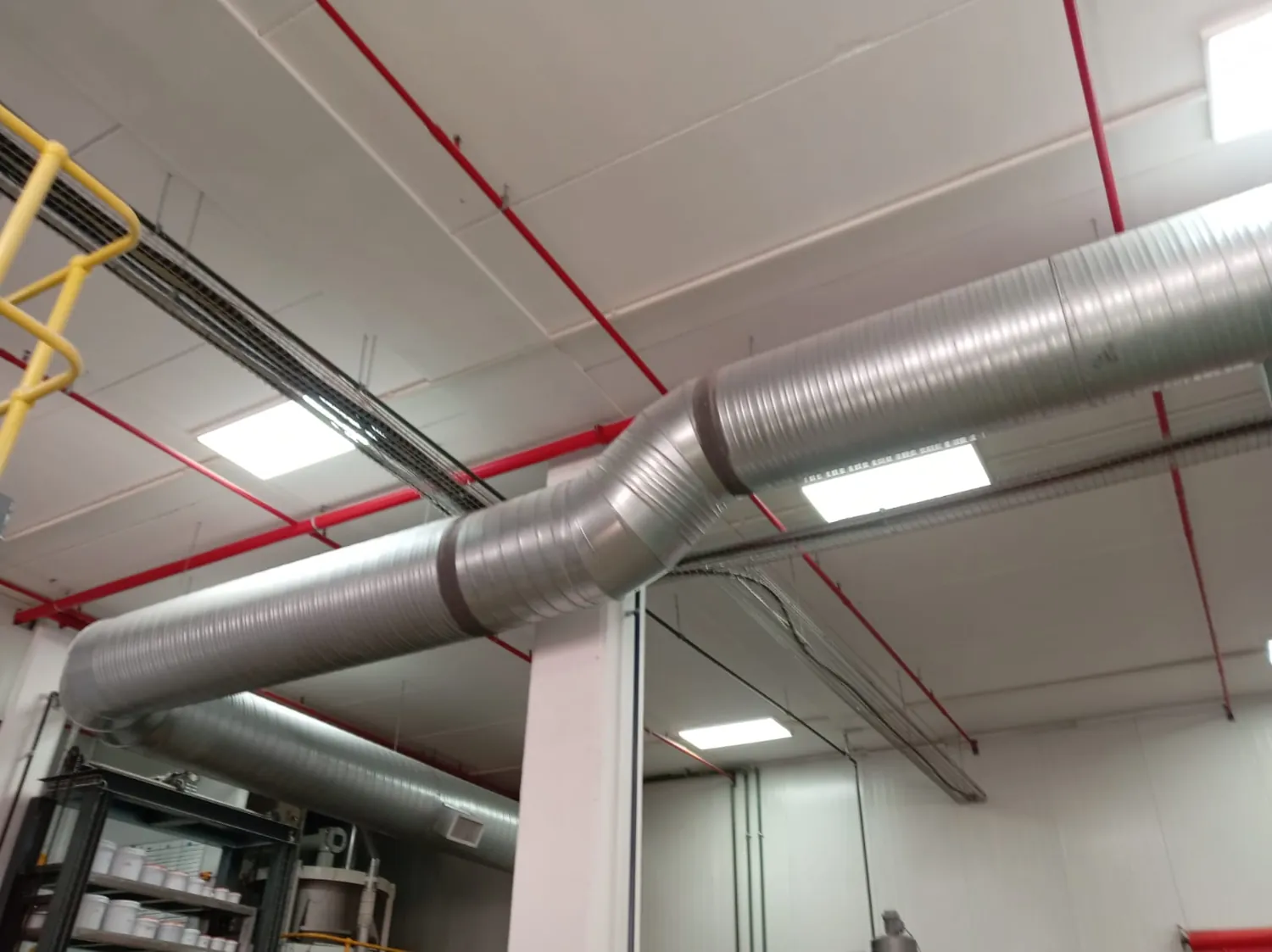
We first look at the route: high-bay spans, ceiling services, structural members, access equipment and the locations of fans or extraction points. Space at elbows, transitions and branch pieces matters because overly tight connections can complicate installation and future maintenance. In an existing factory, the sequence of work should protect normal production activities.
How we approach the work
Our ducting work may include new suspended runs, extensions, replacement of damaged lengths and changes to connections at extraction equipment. Sealing, support spacing and specified material thickness form part of the installation scope. For dust collection, duct configuration needs to consider the particular particulate and intended transport conditions.
Technical suitability and safe operation
Spiral duct is not suitable for every corrosive, abrasive or hot process. We discuss the handled airstream before treating it as the default choice. Photos can show the physical work but cannot independently establish a system measured airflow.
Information that helps us prepare your quotation
Share building photographs, proposed route, ceiling heights, duct sizes if known, fan location and what the duct will carry. We can discuss site measurements and quotation requirements.
Transitions and branches
Changes in direction and cross-section affect the network. Careful transitions and sensible branch connections are important when integrating a new run into an existing extraction system.
Equipment and operating considerations
Spiral ducting is practical for many ventilation routes, but the diameter and joint system must match the intended duty. Air carrying dust or grease is not equivalent to clean supply or exhaust air. We discuss support spacing, access above ceilings, transitions to equipment and how bends affect resistance. Large suspended sections require attention to lifting and secure support. Before fabrication or installation, accurate dimensions and service-routing information are needed so connections align without excessive on-site adaptation.
Planning the project with your operations team
Start with your site and equipment details
Existing ductwork and installation interfaces
Spiral ductwork offers a practical route for many ventilation arrangements, but the correct gauge, connection method and support spacing depend on what the airstream carries. Ordinary clean-air ventilation cannot be assumed suitable for heavy abrasive dust or grease-laden commercial kitchen exhaust. We would check the duct diameter against fan duty and available space, then plan access to joints and dampers. Any route passing through roofs or fire separations needs the relevant building and safety design input.